
Control. Automate. Uncover the truth.
Strata Operations
An engineering control-room strategy game, framed as a murder investigation across parallel dimensions. You never pilot a unit. You run the vessel, author the doctrines, and read the telemetry that comes back.
You were framed, and you cannot go back
You were a researcher, convicted of a murder you did not commit, on fabricated evidence and edited records. Appeal is not an option. Neither is going back in person.
What you have is a dimensional vessel, a refuge stratum nobody is watching, and robot teams you can send into parallel strata to gather what the record left out. Vindication is an engineering problem: infrastructure, logistics, doctrine, and patient reconstruction of the truth.
 Design pillars
Three things this game is about
Operational time
Nothing advances while you think. Pause the vessel to analyse and reconfigure, then run it at 1x, 2x, or 4x and watch how your decisions actually behave. Speed is a supervision setting, not a difficulty slider.
Autonomous operations
You never drive a robot. You write the doctrine it follows, equip it, route it, and send it out. It comes back with resources, logs, evidence — and with the failure data that tells you what your doctrine got wrong.
Readable systems
Every number arrives with its cause attached. Not "factory at 70%", but 70% because alloy supply is intermittent, because the refinery output is reserved elsewhere — and here is the screen where you change that.
A vessel you supervise, not a base you decorate
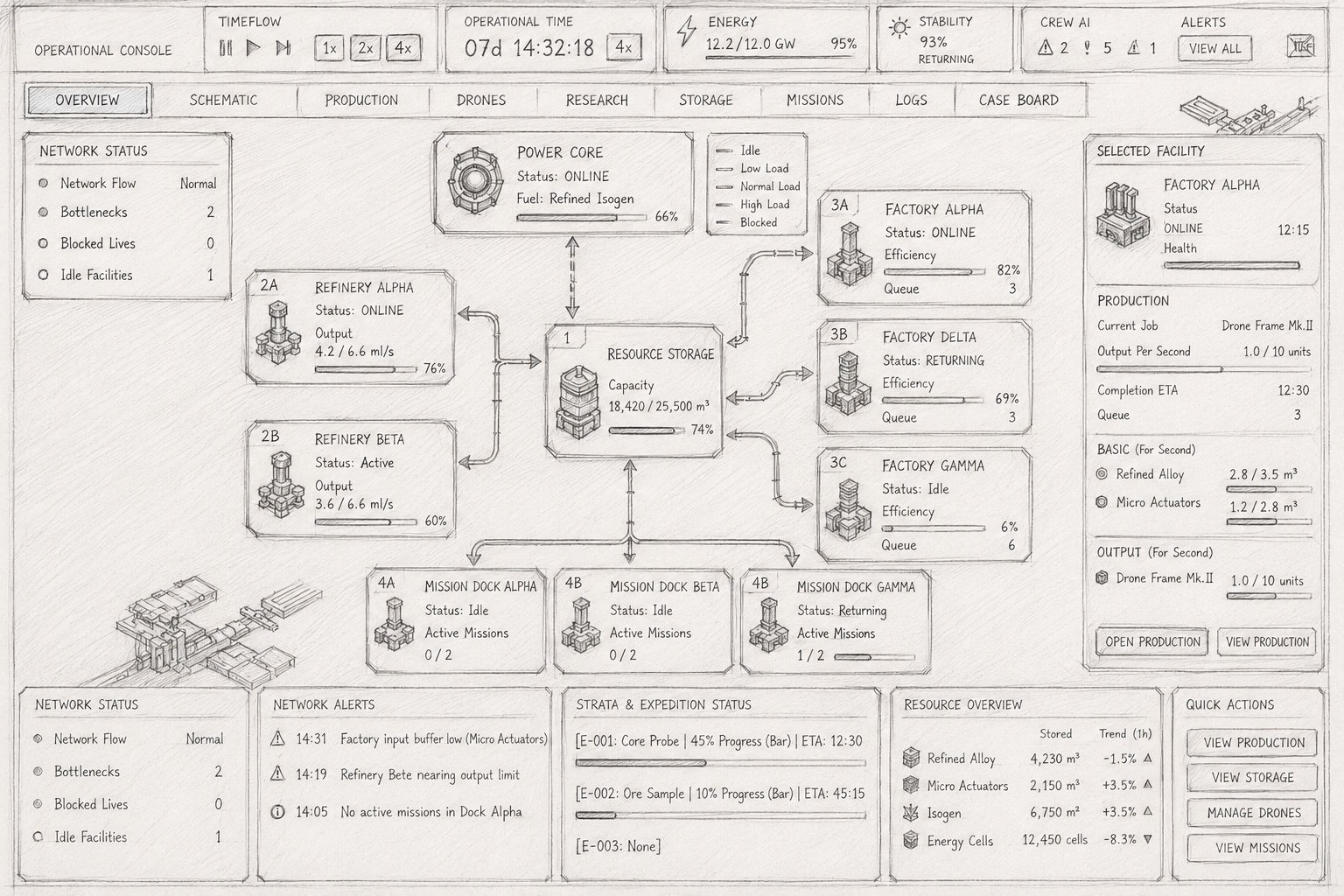
The vessel is presented as an operational schematic: facilities, the lines between them, and the pressure running through both. It is built to be read at a glance and to answer the question underneath every alert — what is wrong, why, and where do I fix it.
Facility state
Idle, starved, throttled, output-blocked, degraded — with the current job and what it is waiting on.
Line load
What each transport line is carrying, how close to capacity it is running, and which queues back up when it saturates.
Root cause
Warnings name the actual origin of a problem, not just the symptom that surfaced first.
Readiness blockers
Select an operation and the vessel highlights every system standing between you and being able to run it.
No room placement, no corridor drawing, no crew to walk between buildings. You supervise a system — you don't decorate a base.
Pause. Diagnose. Dispatch. Run.
- Read the vessel Paused, with everything inspectable: alerts, blocked processes, damaged robots, energy pressure, and what the last operation brought home.
- Find the real problem Trace an underperforming facility back through its inputs to whatever is actually constraining it.
- Re-plan and dispatch Change priorities, refits, doctrines, power budgets, research. Then choose a stratum, a team, and a focus, and send them.
- Let it run Advance time and supervise. A well-built system earns you longer quiet stretches; a bad one interrupts you sooner, and tells you exactly why.
The truth is reconstructed, not discovered
Missions return fragments: partial records, physical traces, and witnesses who exist in one stratum and not another. None of it is a solution on its own. The case board is where fragments become an argument — contradictions between strata, leads worth the energy cost of chasing, and verification questions that have to be answered before a reconstruction will hold.
It is a deliberately separate surface from the vessel schematic, and it looks nothing like it. One tells you how your machine is running. The other tells you how close you are to proving what happened.
Early development
Strata Operations is in early development and does not have a release date. There is no store page yet. Everything shown here is concept work and subject to change.
- Platform PC first, via Steam
- Mode Single-player
- Business model Premium — no ads, no microtransactions
- Release No date announced
- Studio DiceParse Studio
Follow development
We post progress as it happens. Come ask questions, or get in touch directly.